

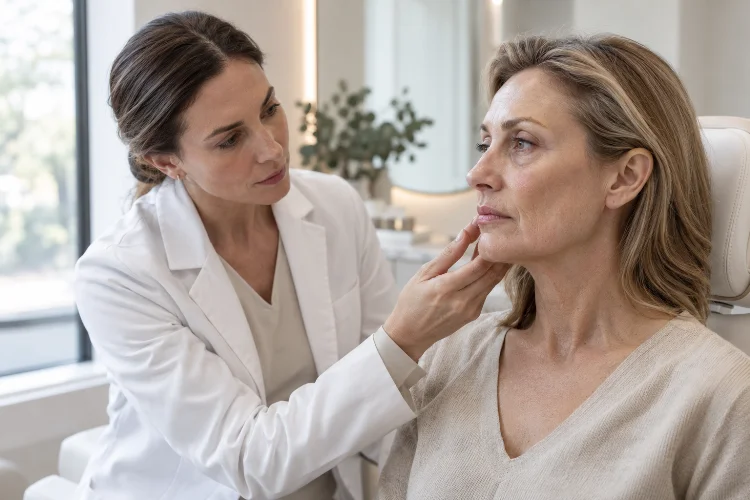
A wrinkle is rarely just a wrinkle.
A deepening nasolabial fold, hollow temple, softer jawline, or tired-looking under-eye area may be the visible result of changes happening across several layers of the face at the same time.
Skin becomes thinner, collagen declines, fat compartments change volume and position, supporting ligaments behave differently, and facial bones gradually remodel with age.
That complexity is why modern facial rejuvenation increasingly moves away from simply filling individual lines.
Advanced facial ageing analysis for aesthetic treatment planning looks at the face as an interconnected anatomical system.
Research on facial ageing shows that meaningful changes occur in the skin, fat compartments, muscles, retaining ligaments, and underlying skeleton, with the pattern and speed varying between individuals.
A good assessment therefore asks a more useful question than “Where is the wrinkle?”
It asks why that wrinkle, hollow, shadow, or contour change appeared in the first place.
Understanding the cause makes it easier to choose a treatment that supports facial balance rather than simply adding volume wherever ageing becomes visible.
Facial Ageing Happens in Multiple Anatomical Layers
The face is not one continuous piece of soft tissue.
Anatomically, it contains several interacting layers, including skin, superficial fat, the superficial musculoaponeurotic system or SMAS, deep fat compartments, muscles, retaining structures, and bone.
One commonly used anatomical model describes five major facial layers from skin down to periosteum or deep fascia.
Each layer ages differently.
Skin may lose collagen, hydration, elasticity, and even pigmentation. Deep facial fat may lose volume in selected areas, while superficial fat can shift or become more noticeable elsewhere. Bone remodeling can reduce structural projection around areas such as the orbit and midface.
Because these processes happen together, treating only the surface can sometimes miss the real cause of an ageing feature.
A hollow cheek, for example, may involve both loss of deep support and changes in overlying tissue rather than simply “not enough filler.”
Start With Facial Shape and Structural Support
Aesthetic assessment usually begins with the overall face rather than individual wrinkles.
Clinicians may evaluate facial width, projection, symmetry, upper-to-lower facial proportions, temples, cheek structure, jawline, chin, and the relationship between different facial thirds.
This provides context.
Someone with good midface projection but noticeable skin laxity may require a very different strategy from someone whose facial ageing is dominated by deep volume loss.
Bone also deserves attention because the facial skeleton changes throughout adulthood. Reviews of facial ageing describe remodeling of the orbital region, maxilla, mandible, and other structures as part of the ageing process.
When skeletal support decreases, overlying tissues may become less supported.
This is one reason treating a visible fold without examining the surrounding architecture can produce an unnatural result. The fold may simply be the endpoint of changes occurring several centimetres away.
Analyse Facial Fat Compartments, Not Just Volume Loss
Older aesthetic thinking often described facial ageing as generalized volume loss.
The reality is more complicated.
Facial fat exists in separate superficial and deep anatomical compartments rather than as one continuous layer. Research mapping these compartments has shown that areas such as the cheeks, forehead, orbit, and jaw contain distinct regions that can age differently.
Some compartments may deflate while others become more prominent or descend relative to neighbouring structures.
For example, changes in deep medial cheek support may contribute to a flatter midface, while differences between adjacent compartments can make folds or shadows appear stronger.
This is why adding equal amounts of volume everywhere rarely produces sophisticated rejuvenation.
Advanced assessment considers where volume has changed, which compartment is involved, and whether the apparent problem is true deflation, tissue displacement, laxity, or a combination.
Research on facial fat compartments increasingly supports this individualized approach.
Evaluate Retaining Ligaments and Tissue Descent
Facial retaining ligaments connect soft tissue to deeper structures and help maintain the position of facial tissues.
Ageing does not simply make these structures disappear, but changes in surrounding fat, bone, connective tissue, and mechanical support can alter how facial tissues sit around them.
This becomes visually important because some folds and contour transitions develop near relatively fixed retaining structures.
As adjacent tissue changes position, visible grooves may become deeper.
The nasolabial fold, jowl area, and transitions around the lower eyelid and cheek are examples where multiple anatomical structures interact.
A layer-based analysis therefore looks beyond the fold itself. Reviews discussing the ageing face emphasize that bone remodeling, fat changes, ligaments, muscles, and skin all contribute to the final appearance.
This can prevent the common mistake of simply adding product directly into every visible line.
Separate Dynamic Ageing From Static Ageing
A face should never be analysed only while completely still.
Ask someone to smile, frown, raise their eyebrows, squint, speak, or purse their lips and the anatomy changes immediately.
These movements reveal how facial muscles influence visible ageing.
1. Dynamic lines
Dynamic wrinkles appear mainly during muscle contraction. Forehead lines, glabellar lines, and crow’s feet commonly begin this way.
Over many years, repeated movement combined with changes in dermal collagen and elasticity can make some lines increasingly visible even at rest.
2. Static changes
Static wrinkles, folds, hollows, and contour changes remain visible without active expression.
They may involve skin ageing, volume changes, altered support, or several mechanisms simultaneously.
Modern aesthetic planning considers both. Expert recommendations on multimodal facial rejuvenation emphasize evaluating muscle activity alongside structural and skin changes because ageing affects multiple interconnected layers.
Ignoring movement can produce results that look acceptable in photographs but unnatural during conversation.
Assess Skin Quality Separately From Facial Structure
Structural rejuvenation cannot automatically correct poor skin quality.
A person may have excellent facial proportions but still show sun damage, pigmentation, fine lines, roughness, enlarged-looking pores, redness, or reduced elasticity.
These features require a different analysis.
Skin assessment may consider hydration, pigmentation, vascular changes, texture, collagen loss, photodamage, scarring, and laxity.
This distinction matters because fillers cannot directly correct every surface problem. Similarly, resurfacing treatments cannot restore major skeletal or deep-volume changes.
A patient with fine photoageing may benefit primarily from skincare or appropriately selected resurfacing techniques, while someone with substantial structural deflation may require an entirely different approach.
Treating the right anatomical level is one of the central ideas behind contemporary facial rejuvenation.
Use Light, Shadows, and Multiple Viewing Angles
Facial ageing is often easier to understand through shadows than through wrinkles.
A hollow temple creates shadow. Loss of cheek projection changes how light travels across the midface. Tear-trough changes can create a tired appearance even when the skin itself is relatively smooth.
This is why assessment should include the face from the front, oblique angles, and profile.
Different lighting can also reveal changes that flat frontal photographs hide.
Profile assessment is especially useful for examining chin projection, jaw contour, neck relationship, and overall facial balance.
Standardised photography can make this process more consistant by allowing changes to be compared under similar lighting, camera position, expression, and head orientation.
The aim is not mathematical perfection. Human faces naturally contain asymmetry.
The purpose is to understand each person’s baseline anatomy before making changes.
Match Treatment to the Cause of the Ageing Sign
Once facial ageing has been mapped, treatment planning becomes more logical.
Dynamic muscle-related lines may be addressed differently from volume loss. Changes in skin texture may require skincare, resurfacing, or other dermatological procedures.
Significant soft-tissue descent may not respond adequately to treatments designed primarily for hydration or volume replacement.
Likewise, injectable fillers can potentially restore selected areas of lost volume, but successful use depends on appropriate indication, placement, facial anatomy, and realistic expectations.
Modern rejuvenation is therefore increasingly multimodal.
A treatment plan might address skin quality first, structural support elsewhere, and muscular activity separately rather than expecting one treatment to solve every sign of ageing.
This approach can also help avoid overtreatment.
If the underlying problem is laxity rather than genuine volume loss, repeatedly adding volume may eventually make the face look heavier without correcting the orginal cause.
Prioritize the Changes That Influence the Whole Face
Not every ageing feature needs to be treated.
A sophisticated plan identifies which changes have the greatest influence on overall facial balance.
For example, restoring support in a structurally appropriate midface area may change several nearby transitions simultaneously. Conversely, chasing every small line individually can create unnecessary treatment without significantly improving overall harmony.
This is where consultation and treatment sequencing become important.
Research on ageing-face evaluation emphasizes a multifaceted approach that considers skin, soft tissue, and the bony skeleton while also discussing realistic expectations with the patient.
The goal should not automatically be to recreate a much younger face.
A more realistic objective is often to improve proportions, soften selected ageing cues, preserve individual identity, and produce a result that remains believable during both rest and movement.
Safety Must Be Part of Facial Analysis
Detailed anatomical assessment is not only about aesthetics.
It also matters for safety.
The face contains complex vascular networks, nerves, muscles, and anatomical spaces.
Expert consensus on facial anatomy education has identified knowledge of muscles, superficial and deep fat, retaining ligaments, anatomical spaces, periosteum, and the SMAS as important for practitioners performing nonsurgical aesthetic procedures.
Injectable and energy-based treatments therefore should not be planned solely from before-and-after trends seen online.
Medical history, previous procedures, medications, facial anatomy, treatment risks, and realistic goals all matter.
For anyone considering medical aesthetic treatment, choosing an appropriately qualified clinician with strong facial-anatomy knowledge is considerably more important than choosing treatment based only on price or popularity.
Advanced facial ageing analysis for aesthetic treatment planning works best when the face is viewed as a connected anatomical system rather than a collection of wrinkles.
Skin quality, facial fat compartments, retaining structures, muscles, skeletal support, movement, proportions, and even the way light creates facial shadows can all influence what we recognise as ageing.
Understanding those layers makes treatment planning more precise and can help avoid unnecessary volume or procedures that target the wrong problem.
Before considering facial rejuvenation, focus first on identifying why a particular feature has changed. Then discuss treatment options, limitations, risks, and realistic outcomes with an appropriately qualified aesthetic medical professional.
The most natural-looking treatment plan is rarely the one that changes everything. It is the one that understands what actually needs changing.