
Hair growth looks simple from the outside. A strand appears, grows for a while, falls out, and eventually gets replaced.
Inside the scalp, things are considerably more complicated.
Each hair follicle is a miniature organ containing stem cells, dermal papilla cells, blood vessels, sebaceous structures, and signalling pathways that repeatedly coordinate periods of growth and rest.
Hormones, genetics, inflammation, nutrition, medications, illness, and ageing can all interfere with that cycle.
That is why advanced hair growth strategies based on follicle biology start with understanding what the follicle is actually doing.
For example, androgenetic alopecia gradually miniaturizes genetically susceptible follicles, while telogen effluvium causes unusually large numbers of follicles to enter the resting phase.
Those conditions may look similar when hair starts filling the shower drain, but their biology – and therefore their treatment – can be very different.
The smartest hair-growth plan is therefore not automatically the one using the most treatments. It is the one targeting the biological process that is limiting growth.
Understand the Hair Growth Cycle First
Every scalp follicle repeatedly moves through several biological phases.
1. Anagen is the active growth phase
During anagen, cells inside the follicle divide rapidly and produce the hair shaft. Healthy scalp follicles can remain in this stage for years, which allows hair to grow long.
2. Catagen is the transition phase
Catagen is comparatively short. Follicular activity slows, the lower portion of the follicle regresses, and the hair prepares to enter its resting stage.
3. Telogen is the resting phase
During telogen, the follicle remains relatively inactive before the old hair eventually sheds and a new growth cycle begins.
Hair loss disorders frequently alter the balance between these stages.
In androgenetic alopecia, the anagen phase becomes progressively shorter while susceptible follicles undergo miniaturization. Eventually, previously thick terminal hairs become shorter, finer, and less visible.
This explains why successful treatment often requires months.
You are changing a biological cycle, not simply making an existing strand grow faster overnight.
Target Follicle Miniaturization in Pattern Hair Loss
Androgenetic alopecia is the most common chronic form of hair loss.
In genetically susceptible follicles, androgen signalling – particularly involving dihydrotestosterone, or DHT – contributes to progressive follicular miniaturization. The dermal papilla becomes smaller, anagen shortens, and each new hair can emerge thinner than the one before it.
This is why early intervention can matter.
A follicle producing thinner hairs may still have biological activity. Once long-standing miniaturization becomes advanced, restoring meaningful density becomes more difficult.
Minoxidil supports the growth phase
Topical minoxidil remains one of the best-established treatments for pattern hair loss. Its exact biology is complex, but it can promote follicular activity and help prolong anagen.
The American Academy of Dermatology notes that minoxidil can stimulate hair growth and reduce further loss, although visible results commonly require around six to twelve months and benefits are lost after treatment stops.
Consistency therefore matters more than expecting dramatic changes after several weeks.
Reduce Androgen Signalling When Appropriate
Minoxidil stimulates growth, but it does not directly eliminate the androgen-driven mechanism behind male pattern hair loss.
That is where treatments such as finasteride can play a different role.
Finasteride inhibits type II 5-alpha-reductase, reducing conversion of testosterone into DHT. By reducing DHT signalling, it can slow the miniaturization process in susceptible follicles.
The AAD reports that finasteride slows additional hair loss in many men and may stimulate some regrowth, particularly when treatment begins earlier. Results generally require several months and treatment must continue to maintain the benefit.
Finasteride is prescription medication and can cause adverse effects, including sexual side effects in some patients. It is therefore something to discuss with a qualified clinician rather than self-prescribe.
Female pattern hair loss is more complicated.
Although follicular miniaturization also occurs, androgen biology in women is less straightforward.
A 2025 clinical review notes that topical minoxidil remains the only FDA-approved treatment for female pattern hair loss, while antiandrogen therapies may be considered for selected patients depending on factors such as age, hyperandrogenism, contraception needs, and medical history.
Use Microneedling as an Adjunct, Not a Miracle Treatment
Microneedling creates controlled micro-injuries in the scalp.
Those injuries can activate wound-healing pathways and growth-factor signalling, which may influence follicular activity. Microneedling may also alter the delivery of topical treatments.
A 2025 systematic review and meta-analysis involving 12 randomized trials found that combining microneedling with topical minoxidil improved hair count compared with minoxidil alone, although study results were heterogeneous.
That does not mean everyone needs deeper needles or more frequent treatment.
Interestingly, the same analysis found no clear advantage for particular needling depths or durations in the available trials.
And newer research reminds us that evidence is still evolving. A 2026 randomized trial involving women with androgenetic alopecia found that adding microneedling every two or four weeks did not significantly outperform topical minoxidil alone after 24 weeks.
So microneedling may be useful as part of a combined strategy, but the ideal protocol remains far from settled.
Understand What PRP Is Trying to Do
Platelet-rich plasma, or PRP, takes a very different approach.
A patient’s blood is processed to concentrate platelets, and the resulting plasma is injected into the scalp. Platelets release numerous signalling molecules and growth factors that may influence tissue repair, angiogenesis, and follicular activity.
A 2024 systematic review examining PRP for male androgenetic alopecia found that several randomized trials reported improvements in hair density or hair count.
However, the authors also highlighted substantial variation in PRP preparation methods and overall limitations in evidence quality.
That variability matters.
“PRP” is not one perfectly standardized product. Platelet concentration, centrifugation technique, injection schedule, activation method, and treatment intervals can differ substantially between clinics.
A separate 2024 meta-analysis of randomized clinical trials also found potential benefits for hair density, while emphasizing differences across protocols.
PRP may therefore be a useful adjunct for selected patients, but it should not be presented as guaranteed follicle regeneration.
Consider Low-Level Light Therapy
Hair follicles also respond to light-based biological signalling.
Low-level laser or LED therapy, often called LLLT or photobiomodulation, generally uses red or near-infrared wavelengths. The proposed mechanisms involve mitochondrial signalling, ATP production, inflammatory modulation, and pathways that may support anagen activity.
A 2024 systematic review and meta-analysis evaluated 38 studies involving more than 3,000 participants across different forms of alopecia.
Most participants had androgenetic alopecia, and the analysis found evidence supporting improved hair density with low-level light therapy in appropriate groups.
The AAD also describes at-home laser devices as a possible treatment option for hereditary hair loss, although results depend on consistent long-term use.
Device quality matters.
Wavelength, power, treatment duration, scalp coverage, and frequency all influence the dose delivered to follicles.
Wearing an inexpensive red-light device occasionally is therefore not necessarily equivalent to using a clinically studied protocol.
Do Not Ignore Scalp Inflammation
A follicle does not exist independently of the scalp around it.
Chronic inflammation can interfere with normal cycling, and certain forms of alopecia involve inflammatory or autoimmune mechanisms that require very different treatment.
Redness, persistent itching, burning, heavy scaling, pustules, or painful areas of hair loss should therefore not automatically be treated with another growth serum.
Scarring alopecias are especially important to identify early.
When inflammation permanently destroys the follicular structure and replaces it with scar tissue, stimulating growth becomes far more difficult. In these situations, the priority is controlling the inflammatory disease before additional follicles are damaged.
This is one reason dermatologist evaluation becomes valuable when hair loss is patchy, painful, rapidly progressive, or accompanied by obvious scalp abnormalities.
Follicle biology comes before product selection.
Correct Nutritional Problems Without Chasing Supplements
Hair production requires substantial cellular activity, so nutritional status can influence growth.
Iron, protein, zinc, vitamin D, and other nutrients participate in biological processes relevant to hair follicles. However, taking large doses of supplements does not automatically make healthy follicles grow faster.
The better strategy is identifying genuine deficiency.
A 2026 systematic review and meta-analysis found that people with telogen effluvium had lower ferritin and vitamin D levels on average than controls, although the studies showed considerable heterogeneity.
This does not mean every person experiencing shedding should immediately take iron or vitamin D.
Excessive supplementation can also create problems.
If diffuse shedding follows major dietary restriction, illness, substantial weight loss, pregnancy, surgery, or prolonged stress, medical evaluation and appropriate laboratory testing may be more useful than buying a generic “hair vitamin.”
Correct what is deficient rather than assuming more nutrients always equal more growth.
Match the Strategy to the Cause of Hair Loss
This is probably the most important part of advanced hair-growth planning.
A person with androgenetic alopecia may benefit from treatments that prolong anagen and reduce follicular miniaturization.
Someone experiencing telogen effluvium after major illness may instead need the triggering factor corrected while the follicular cycle naturally recovers.
Alopecia areata involves immune-mediated follicle disruption and requires a completely different treatment approach.
Scarring alopecia requires inflammation control.
Mechanical hair loss from tight hairstyles requires eliminating repeated traction.
These conditions can even occur together.
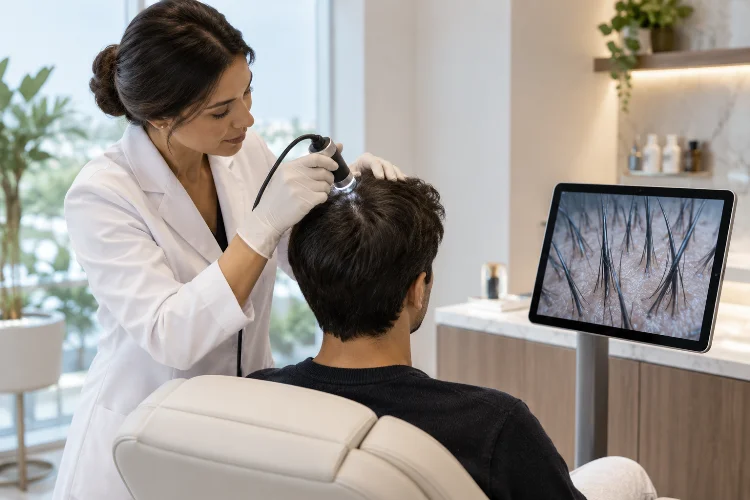
That is why a dermatologist may examine the scalp closely, use dermoscopy or trichoscopy, review medications and medical history, perform a hair-pull test, request blood tests, or occasionally take a scalp biopsy before recommending treatment.
The AAD emphasizes that determining the cause is a critical first step because different types of hair loss require different therapies.
Measure Progress in Hair Cycles, Not Weeks
Hair treatment is a patience test.
Because follicular cycling happens slowly, meaningful improvement generally takes months rather than days.
Take standardized photographs every one to three months using similar lighting, hairstyle, camera distance, and scalp positioning.
Do not judge progress based purely on how much hair appears in the shower on one particular morning.
Temporary shedding fluctuations happen naturally.
For treatments such as minoxidil or finasteride, continued use is usually necessary to maintain results. Stopping a therapy that was successfully supporting follicles often allows the underlying hair-loss process to resume.
A consistant six-month strategy is usually more informative than switching products every three weeks.
Advanced hair growth strategies based on follicle biology work because they target the process responsible for hair loss rather than simply trying to make strands look thicker.
Pattern hair loss involves follicular miniaturization and shortened anagen cycles, which helps explain the roles of treatments such as minoxidil and, for appropriate patients, antiandrogen therapy.
Microneedling, PRP, and low-level light therapy may provide additional options, but their effectiveness can depend heavily on protocol and patient selection.
Nutrition matters too, especially when real deficiencies are present, but random supplementation is rarely a complete solution.
If your shedding is sudden, patchy, painful, rapidly progressing, or accompanied by scalp inflammation, start with a dermatological diagnosis.
Understanding why the follicle is struggling is the most important step toward choosing a treatment with a realistic chance of working.