

Hair ageing is easy to notice but surprisingly complex underneath the scalp. One day you may realize your hair feels thinner, grows more slowly, looks less shiny, or suddenly contains far more grey strands than it did a few years ago.
These changes do not happen only to the visible hair shaft. The follicle itself is a tiny regenerating organ, containing epithelial stem cells, melanocyte stem cells, dermal papilla cells, sebaceous structures, immune cells, and a specialized surrounding tissue environment.
Understanding how hair follicles change during biological ageing means looking at all of those components together.
Research shows that ageing can reduce hair-follicle regenerative capacity, alter stem-cell activity, change the surrounding extracellular matrix, increase cellular senescence, and interfere with pigmentation.
More recent expert consensus also describes ageing hair as a combination of reduced density, follicular miniaturization, pigment loss, and declining hair-fibre quality.
So ageing hair is not simply “old hair.” It reflects gradual biological changes occurring throughout the entire follicular system.
The Hair Growth Cycle Becomes Less Efficient
Every follicle repeatedly moves through periods of active growth, regression, rest, and shedding.
The longest stage is anagen, when cells inside the follicle actively produce the hair shaft. Catagen is a short transition period, while telogen represents a resting phase before the old hair is eventually released.
With biological ageing, this regenerative rhythm can become less efficient.
Hair-follicle stem cells depend on signals from their surrounding niche to remain balanced between dormancy and activation.
Age-related changes in those cells and their microenvironment can reduce regenerative potential, making it more difficult for follicles to repeatedly produce strong new hairs.
The visible result may be slower replacement, reduced density, or a greater impression of thinning.
Importantly, ageing does not affect every follicle at exactly the same speed. Genetics, hormones, scalp location, disease, and environmental stress can all modify the process.
Hair Follicle Stem Cells Lose Regenerative Capacity
Hair follicles are unusual because they repeatedly regenerate throughout adult life.
Much of this ability depends on hair-follicle stem cells located in specialized regions such as the bulge. These cells help rebuild portions of the follicle during each new growth cycle.
Ageing gradually changes this stem-cell system.
Recent reviews describe age-related stem-cell exhaustion, altered differentiation, cellular senescence, and deterioration of the surrounding stem-cell niche as potential contributors to declining follicular regeneration.
Think of the follicle as a factory.
Young follicles have efficient workers, clear signals, and a supportive enviroment. With ageing, the workers may still exist, but their instructions become less precise, the surrounding structure changes, and regeneration becomes less reliable.
This does not mean all follicles simply “die” with age. Instead, their ability to repeatedly produce the same quality of hair can gradualy decline.
Dermal Papilla Changes Can Affect Hair Size
At the base of the growing follicle sits the dermal papilla, a specialized cluster of cells that communicates with surrounding follicular cells.
Its signalling helps regulate hair growth, follicle size, and cycling.
Changes in dermal papilla function are especially important in androgenetic alopecia, where susceptible follicles gradually produce smaller hairs. Classic research suggests that reductions in dermal papilla cell number and size may contribute to follicular miniaturization.
Ageing can add another layer.
Cellular senescence, oxidative stress, hormonal signalling, and alterations in the scalp environment may influence dermal papilla cells over time.
Research increasingly connects biological ageing with mechanisms involved in androgenetic alopecia, although pattern hair loss remains a distinct condition strongly influenced by genetics and androgen signalling.
This is an important distinction.
Not every older person with thinner hair has androgenetic alopecia, but ageing and pattern hair loss can overlap.
Follicles May Produce Progressively Finer Hair
One of the most obvious age-related changes is reduced hair volume.
That does not necessarily mean large numbers of follicles suddenly disappear.
Hair may look thinner because individual fibres become finer, density decreases, or both happen simultaneously.
A study of more than 1,000 women found that scalp hair density decreased with age, while hair diameter eventually declined after middle age. Together, these changes made the overall reduction in perceived hair amount increasingly noticeable later in life.
Another study comparing people in their 20s and 50s also found significantly reduced hair density in the older group.
This explains why ageing hair can feel dramatically different even without obvious bald patches.
A ponytail may become smaller, the scalp may become easier to see under bright light, and hairstyles that once looked full may start appearing flatter.
Melanocyte Ageing Turns Hair Grey
Hair colour has its own biological ageing system.
Pigment-producing melanocytes add melanin to the hair shaft during the active growth phase. Those melanocytes are supported by melanocyte stem cells associated with the follicle.
Over time, this system becomes less reliable.
Age-related changes include declining melanogenesis, altered melanocyte function, oxidative stress, and eventual depletion or dysfunction of melanocyte stem cells. When sufficient pigment can no longer be transferred into the growing fibre, hair emerges grey or white.
The American Academy of Dermatology notes that hair commonly begins turning grey during the 30s or 40s, although genetics can make the process begin much earlier or later.
Greying and thinning are therefore related to ageing but are not exactly the same process.
A follicle may continue producing a thick hair while losing pigment, or produce increasingly fine hair while maintaining colour.
Cellular Senescence Changes the Follicle Environment
Cells do not always die when they become damaged or old.
Some enter a state called cellular senescence. They remain alive but stop dividing normally and can release inflammatory signalling molecules collectively associated with the senescence-associated secretory phenotype, or SASP.
Increasing senescent-cell burden is one mechanism being investigated in ageing follicles.
Research suggests that oxidative stress and androgen-related signalling may promote senescence in dermal papilla cells and follicular stem-cell populations, potentially contributing to impaired growth and miniaturization.
The surrounding scalp ages too.
Changes involving collagen, extracellular matrix, blood vessels, subcutaneous tissue, glycation, inflammation, and sebaceous activity may alter the environment in which follicles operate.
Researchers have proposed that scalp ageing and follicular ageing should therefore be considered together rather than as completely separate processes.
A healthy follicle still depends on healthy surrounding tissue.
The Hair Shaft Becomes More Fragile Too
Ageing does not stop once the fibre leaves the follicle.
The hair shaft itself changes.
Studies have documented age-related reductions in properties such as density, diameter, tensile strength, and lustre in some populations. Structural changes within the fibre can also make older hair behave differently during styling.
The cuticle can become more vulnerable to everyday grooming damage as well.
This matters because biological ageing and accumulated external damage happen simultaneously.
A single strand may already be somewhat more fragile because of age, then face repeated blow-drying, straightening, colouring, bleaching, sunlight, brushing, and chemical processing.
Gentler hair care cannot reverse follicular ageing, but it can reduce unnecessary breakage and help preserve the fibres that follicles are still producing.
Hormonal Ageing Can Change Follicle Behaviour
Hormones also influence how ageing hair behaves.
Androgens are particularly important in genetically susceptible follicles affected by androgenetic alopecia.
A major 2025 review describes the condition as progressive follicular miniaturization associated with altered androgen signalling in susceptible scalp regions, especially in men.
Women experience hormonal changes too.
Hair thinning becomes increasingly common after menopause, although female pattern hair loss is biologically more complicated and cannot always be explained by androgen levels alone.
That means age-related hair thinning should not automatically be dismissed as “normal.”
Iron deficiency, thyroid disorders, medication effects, inflammatory scalp disease, telogen effluvium, androgenetic alopecia, and scarring alopecia can all occur later in life.
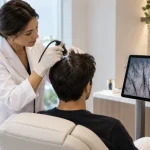
A dermatologist can help distinguish expected biological ageing from a treatable hair-loss disorder.
Can Ageing Hair Follicles Be Protected?
No treatment currently freezes follicles at a permanently youthful biological age.
Still, some modifiable factors matter.
Treat diagnosed scalp inflammation, avoid unnecessary traction, minimize repeated chemical and thermal damage, maintain adequate nutrition, and address genuine deficiencies when they exist.
For people with androgenetic alopecia, evidence-based treatments such as minoxidil and prescription antiandrogen approaches may help preserve susceptible follicles, depending on sex, diagnosis, medical history, and treatment suitability.
The earlier progressive miniaturization is recognized, the more functioning follicular tissue there may be to preserve.
Be sceptical of products claiming to completely “reverse follicle ageing.”
Research into stem-cell ageing, senescence, regenerative signalling, and follicular niches is advancing rapidly, but many proposed anti-ageing interventions remain experimental rather than established clinical treatments.
Hair follicles change during biological ageing because multiple systems gradually become less efficient at the same time.
Stem-cell regeneration declines, the follicular niche changes, dermal papilla signalling may weaken, hair fibres can become finer, and pigment-producing cells progressively lose their ability to maintain colour.
Meanwhile, cellular senescence, oxidative stress, hormones, and ageing scalp tissue can further influence follicular behaviour.
The result may appear as reduced density, slower growth, finer strands, more visible scalp, altered texture, or grey hair.
Some of these changes are normal, but rapid shedding, patchy loss, scalp inflammation, or obvious progressive thinning should not automatically be blamed on age.
If your hair is changing noticeably, document the pattern over several months and consider a dermatologist assessment to separate normal ageing from conditions that can still be treated.