
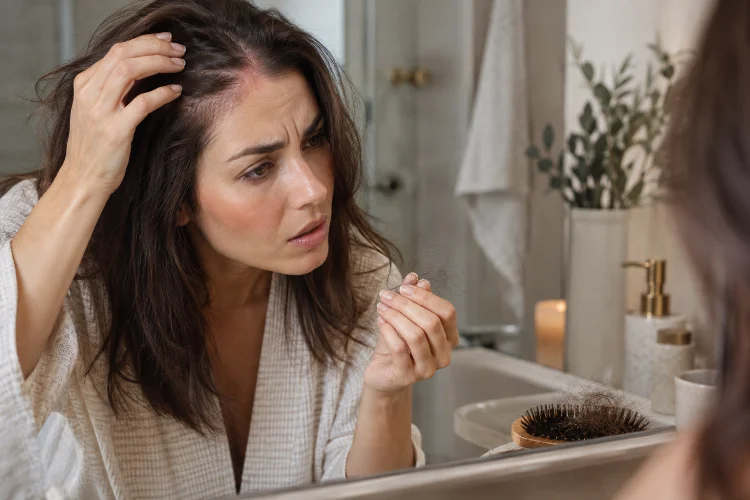
Finding more hair than usual in the shower can immediately make you think about hormones, stress, or nutritional deficiencies. Sometimes, however, the problem is happening much closer to the hair itself.
The scalp is an active biological environment filled with hair follicles, sebaceous glands, immune cells, blood vessels, and microorganisms.
When that environment becomes chronically inflamed, normal follicle function can be disrupted. Itching, scaling, redness, tenderness, or repeated scratching may appear alongside increased shedding.
Understanding how scalp inflammation contributes to persistent hair shedding is important because not every inflamed scalp behaves the same way.
Seborrheic dermatitis and scalp psoriasis often cause temporary shedding that improves once inflammation is controlled.
Other inflammatory disorders can attack structures responsible for regenerating the follicle, potentially leading to permanent scarring hair loss if treatment is delayed. Hair disorders more broadly can alter follicle size, density, or the balance between growth and resting phases.
The key is identifying which process is happening before reaching for another generic hair-growth serum.
Chronic Inflammation Can Disturb the Hair Growth Cycle
A healthy follicle repeatedly cycles through active growth, transition, rest, and shedding.
The longest stage is anagen, when the follicle actively produces a hair shaft. Eventually it enters catagen, followed by the resting telogen stage before the hair is released.
Inflammation can disturb this carefully regulated cycle.
Inflammatory signalling around the follicle may alter the local environment, disrupt normal follicular activity, or push a greater proportion of follicles toward a resting and shedding state.
Reviews of hair-follicle biology describe inflammation as one of several major mechanisms capable of contributing to both scarring and non-scarring alopecia.
This helps explain why scalp disease and increased shedding sometimes appear together.
It also explains why simply applying minoxidil may not solve every case. If ongoing inflammation remains untreated, the biological environment surrounding the follicle is still abnormal.
Seborrheic Dermatitis Creates a Chronically Irritated Scalp
Seborrheic dermatitis is one of the most common inflammatory scalp conditions.
Typical symptoms include flaking, greasy or dry scales, itching, redness, and irritation. It tends to follow a chronic, relapsing pattern rather than disappearing permanently after one treatment.
A 2024 international expert consensus describes scalp seborrheic dermatitis as a chronic inflammatory condition requiring both flare treatment and ongoing maintenance strategies.
The condition involves a complicated interaction between sebum, skin-barrier function, individual susceptibility, immune responses, and Malassezia yeast.
Hair loss is not usually the defining feature, but persistent inflammation, scratching, and scalp irritation may contribute to noticeable shedding in some people.
This is why treating only the hair shaft misses the point.
The American Academy of Dermatology notes that dandruff shampoos containing appropriate active ingredients, prescription antifungals such as ketoconazole or ciclopirox, and sometimes anti-inflammatory medication may be used depending on severity.
Once inflammation settles, shedding related to scalp irritation may also improve.
Scalp Psoriasis Can Increase Temporary Hair Loss
Psoriasis creates a different type of inflammation.
It is an immune-mediated condition in which skin-cell turnover accelerates dramatically, producing thick, scaly plaques. At least half of people with plaque psoriasis experience scalp involvement at some point.
Scalp psoriasis does not usually destroy hair follicles directly.
However, hair shedding can increase during active disease. A recent review notes that hair loss associated with scalp psoriasis is often related to telogen effluvium, although several mechanisms can be involved.
Scratching adds another problem.
Itching can become intense, and forcefully removing thick scale may pull hairs out along with it. The AAD advises gently loosening scales rather than picking or aggressively combing them because mechanical trauma can worsen inflammation and hair loss.
The encouraging part is that this hair loss is frequently reversible.
Once scalp psoriasis is controlled and follicles remain intact, normal growth can usually resume.
Folliculitis Can Put Inflammation Directly Around the Follicle
Sometimes inflammation is concentrated directly around individual hair follicles.
This is called folliculitis.
Folliculitis can develop for several reasons, including bacterial infection, fungal involvement, irritation, occlusion, or inflammatory skin disorders. The scalp may develop small red bumps, pustules, tenderness, itching, or crusting.
Occasional mild folliculitis does not automatically mean permanent hair loss.
Persistent or severe follicular inflammation is more concerning because repeated damage directly around the follicle can interfere with healthy growth.
Scalp microbiome research also suggests that microbial changes may accompany several inflammatory follicular disorders.
A 2026 systematic review found recurrent alterations involving Staphylococcus and Cutibacterium across conditions including seborrheic dermatitis and some alopecias, although researchers emphasized that these associations do not yet prove causation.
That distinction matters.
Trying to “rebalance the microbiome” with random scalp products is not a substitute for diagnosing pustules, crusting, or painful inflammation.
Scarring Alopecia Is Where Inflammation Becomes More Serious
Not all inflammatory hair loss is reversible.
Scarring alopecia, also called cicatricial alopecia, describes a group of disorders in which inflammation ultimately destroys important follicular structures and the follicle is replaced by fibrous scar tissue.
Once that destruction is complete, the follicle cannot simply restart a normal growth cycle.
Conditions in this group include lichen planopilaris, frontal fibrosing alopecia, and central centrifugal cicatricial alopecia, among others.
Research on primary scarring alopecia shows that follicle-centred inflammation can involve sebaceous glands and other structures early in the disease process. One histological study found substantially greater sebaceous-gland loss in scarring alopecia than in non-scarring forms.
More recent molecular research has found inflammatory pathways involving immune-cell infiltration and signalling systems such as interferon and JAK/STAT pathways across several lymphocytic scarring alopecias.
Symptoms may include burning, tenderness, itching, redness, scaling around follicles, or gradually enlarging areas of thinning.
Because lost follicles cannot easily be restored, controlling inflammation early is the priority.
Scratching and Harsh Hair Care Can Make the Problem Worse
An itchy scalp creates a frustrating cycle.
Inflammation causes itching, scratching injures the skin, and additional irritation can make inflammation worse.
Repeated vigorous scratching may also loosen hairs that were already close to shedding.
The same applies to aggressive scale removal.
With scalp psoriasis, the AAD specifically warns that forcefully removing scales can pull hair with them and aggravate the underlying disease.
Hair-care habits matter too.
Tight hairstyles add mechanical traction, while harsh dyes, chemical straighteners, excessive heat, and irritating scalp products can worsen an already sensitive scalp.
This does not mean shampooing should be avoided.
In conditions such as seborrheic dermatitis, appropriate scalp cleansing and medicated shampoos can be an important part of controlling inflammation.
The goal is gentle, appropriate cleansing—not avoiding washing entirely or scrubbing the scalp until it feels “perfectly clean.”
Treat the Inflammation Before Chasing Regrowth
When shedding occurs together with obvious scalp inflammation, the first question should be what is causing the inflammation.
Treatment will depend on the diagnosis.
Seborrheic dermatitis may respond to antifungal shampoos and anti-inflammatory therapy. Scalp psoriasis may require medicated shampoos, topical corticosteroids, scale-softening treatments, phototherapy, or systemic treatment depending on severity.
Folliculitis may require treatment directed at its underlying cause.
Inflammatory scarring alopecia can require prescription therapies designed to suppress disease activity before additional follicles are permanently damaged.
This is why repeatedly adding hair-growth products can sometimes be the wrong strategy.
A stimulated follicle still needs a healthy enough environment to function.
Once inflammation is controlled, treatments aimed directly at hair growth can be considered if another condition – such as androgenetic alopecia – is also present.
Multiple hair-loss mechanisms can coexist, so treatment sometimes needs to address more than one problem.
Know When Persistent Shedding Needs a Dermatologist
A little dandruff and mild seasonal shedding do not necessarily signal serious disease.
Certain symptoms deserve closer attention, though.
Seek dermatological evaluation when hair loss continues for months, becomes noticeably patchy, progresses rapidly, or occurs together with scalp pain, burning, pustules, bleeding, heavy scaling, or persistent redness.
Areas where the scalp looks unusually smooth or shiny and follicular openings appear to be disappearing are particularly concerning because they may suggest scarring.
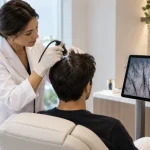
Diagnosis may involve scalp examination and trichoscopy. In uncertain cases, dermatologists sometimes perform a scalp biopsy because clinical appearance alone cannot always distinguish different forms of alopecia.
Do not wait for dramatic bald patches if your scalp is consistently painful or inflammed.
Early diagnosis can make a major difference when follicular destruction is potentially permanent.
Scalp inflammation contributes to persistent hair shedding in several different ways. It may disrupt the normal follicle cycle, encourage telogen shedding, create scratching and mechanical trauma, or directly damage structures around the hair follicle.
Conditions such as seborrheic dermatitis and scalp psoriasis often cause temporary hair loss that improves when inflammation is controlled. Scarring alopecias are different because ongoing immune-mediated damage can permanently destroy follicles.
The practical strategy is therefore to treat the scalp environment rather than focusing exclusively on hair-growth products.
Pay attention to itching, redness, scaling, tenderness, pustules, or burning that accompanies shedding. Use gentle hair care and appropriate treatment rather than aggressive scratching or exfoliation.
If inflammation is persistent, painful, or associated with progressive thinning, arrange a dermatological assessment early. Saving an actively inflamed follicle is usually easier than trying to replace one that has already been destroyed.