
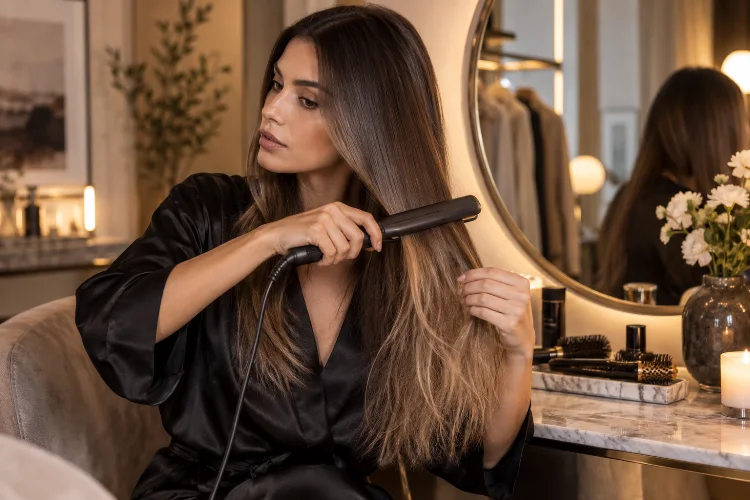
A flat iron can make hair look smoother in minutes. A curling wand can transform texture just as quickly. But while heat styling changes the shape of hair temporarily, repeated high-temperature exposure can gradually change the fibre itself.
Human hair is mainly built from keratin and organized into several structural regions. The outer cuticle protects the internal cortex, while surface lipids help reduce friction and control how the fibre interacts with water.
Once these protective structures become damaged, hair can become rougher, more porous, less flexible, and increasingly prone to breakage.
Understanding how heat styling changes hair fibre structure over time explains why damage often seems to appear suddenly after months or years of styling.
It is rarely one blow-dry or one straightening session that creates the entire problem. Instead, repeated heating, wetting, brushing, chemical processing, and environmental exposure accumulate.
Eventually, the fibre reaches a point where conditioners can temporarily improve feel, but they cannot completely restore the original biological structure.
Start With the Cuticle: Hair’s Protective Outer Layer
The cuticle is made of overlapping cells that sit around the outside of the hair shaft rather like roof tiles.
Its job is to protect the cortex from mechanical, chemical, and environmental stress. A lipid-rich surface containing 18-methyl eicosanoic acid, or 18-MEA, also contributes to smoothness, lubrication, and water resistance.
Repeated heat gradually disrupts this protective surface.
Microscopy studies have shown that high-temperature styling can cause lifted cuticle edges, cracking, fusion between scale edges, and other structural abnormalities.
The higher the temperature and the more frequently the fibre is exposed, the greater the opportunity for damage to accumulate.
Once cuticle cells begin separating or breaking away, friction increases.
Hair then tangles more easily and requires more force to comb. That additional mechanical stress causes even more cuticle loss.
It becomes a classic damage cycle.
Heat Changes the Water Balance Inside Hair
Hair naturally contains water.
That moisture influences flexibility, elasticity, and the way keratin structures respond to styling. When a dryer or straightener heats the fibre, water begins evaporating.
Moderate drying is obviously necessary after washing, but extremely rapid heating can create strong physical stresses.
Research on blow-drying suggests that evaporation and temperature changes can generate contraction stresses around the cuticle, contributing to lifting and cracking of its cells.
Interestingly, blow-drying itself is not automatically the worst option.
One experimental study comparing several drying methods found increasing surface damage as dryer temperature increased.
However, holding a dryer approximately 15 cm from the hair while keeping it continuously moving produced less structural damage than prolonged natural drying under the study conditions.
The practical lesson is not “never use a dryer.”
It is avoid concentrating high heat on one area for too long.
Wet Hair Plus Extreme Heat Is Particularly Risky
Running a very hot flat iron over damp hair can produce much more than ordinary dryness.
Water trapped inside the shaft can rapidly turn into steam.
When internal pressure rises fast enough, tiny cavities can form within the hair fibre. This condition is known as bubble hair.
Bubble hair has been documented after heated tools were applied to wet or damp hair. Microscopic examination shows air-filled spaces inside the fibre, and affected hairs become dry, brittle, and much easier to fracture.
Studies using curling irons have similarly found more severe structural changes when wet hair is exposed to heat. Damage included bubbling, cuticle buckling, cracking, and deformation associated with steam escaping from the fibre.
This makes one rule especially important:
Hair should generally be appropriately dry before using a flat iron or curling iron unless the appliance has specifically been designed and validated for wet-to-dry use.
Spraying hair until it is visibly wet immediately before intense ironing can also be problematic.
Research comparing heat-protection sprays found more structural damage when additional water was present during straightening, even though protective formulations reduced some protein-related damage.
Repeated Heat Eventually Affects the Cortex
The cortex makes up most of the hair fibre.
It contains organized keratin structures responsible for much of hair’s mechanical strength, elasticity, and shape. The cortex is normally protected by the surrounding cuticle.
But that protection becomes weaker as weathering progresses.
A recent structural study using microscopy, spectroscopy, and X-ray techniques found that heating can produce changes not only at the surface but within the hierarchical organization of the hair fibre, particularly when hair has already been chemically treated.
Keratin organization matters because hair’s strength depends partly on these highly structured proteins.
Once protein structures and surrounding bonding systems become significantly altered, the fibre may lose tensile strength and become increasingly fragile.
This is when hair starts snapping instead of merely feeling dry.
And because the visible hair shaft consists of dead keratinized tissue, severe structural damage cannot biologically “heal” in the way living skin can.
Conditioners can improve lubrication and temporarily fill irregularities, but the original fibre cannot regenerate itself.
Chemical Processing Makes Hair More Heat-Sensitive
Bleached hair and repeatedly straightened hair deserve extra caution.
Chemical processing already modifies the cuticle, surface lipids, keratin, and internal bonding structures. Bleaching in particular increases porosity and can weaken the protective architecture of the shaft.
Adding strong heat on top of that damage creates a combined stress.
A 2025 study examining heat exposure in natural, bleached, acid-straightened, and combined chemically treated hair found that previously processed fibres showed greater structural changes under heating.
Fibres exposed to both bleaching and straightening were particularly altered because important surface and internal components had already been compromised.
This helps explain why two people can use the same flat iron at the same temperature and experience very different outcomes.
Virgin, coarse hair may tolerate a particular routine better than fine, bleached, highly porous hair.
The existing condition of the fibre matters almost as much as the temperature.
Damage Accumulates Through Hair Weathering
Hair does not replace damaged sections along its length.
Once a strand emerges from the scalp, that same fibre can remain exposed to washing, sunlight, brushing, colouring, drying, and styling for several years.
Researchers refer to this progressive deterioration as hair weathering.
Weathering typically begins with loss or disruption of the outer protective structures. As cuticle layers erode, the cortex becomes increasingly exposed and vulnerable to further chemical and mechanical damage.
That is why hair near the ends usually looks more damaged than hair close to the scalp.
The ends are simply older.
They may have experienced hundreds of wash cycles, dozens of straightening sessions, repeated UV exposure, brushing, colouring, and friction against clothing or bedding.
Eventually, cracks can propagate further into the fibre and produce split ends or complete breakage. Reviews of hair weathering describe cuticle loss followed by fissures between exposed cortical cells as an important pathway toward shaft fracture.
The damage may feel sudden, but structurally it has often been building for months.
Temperature, Contact Time, and Frequency All Matter
There is no single temperature that is perfectly safe for every head of hair.
The amount of thermal stress depends on multiple variables: temperature, contact time, number of passes, frequency of styling, moisture level, hair diameter, chemical history, and existing damage.
Holding a curling iron on one section for a prolonged period creates more opportunity for thermal injury than brief controlled contact.
Likewise, passing a straightener over the same strand five times every morning produces far more cumulative exposure than occasional styling.
Studies on curling irons show that prolonged exposure and repeated heat can cause radial and longitudinal cracking as well as cuticle fusion.
The best temperature is therefore usually the lowest temperature that achieves the desired style efficiently.
Fine, bleached, damaged, or chemically straightened hair generally requires a more conservative approach than resistant, untreated fibres.
A styling tool should make hair easier to manage, not produce smoke, sizzling sounds, or a persistent burnt smell.
Those are not signs of a more effective hairstyle.
Heat Protectants Help, but They Are Not a Force Field
Heat-protection products can reduce certain forms of damage.
Depending on the formulation, they may improve lubrication, reduce friction, modify heat transfer, coat weak cuticle areas, or decrease some protein degradation during styling.
Research comparing protective sprays has demonstrated reduced tryptophan damage after repeated heat exposure, suggesting that properly formulated products can offer measurable protection.
But protection is relative.
A heat protectant does not make extremely high temperatures harmless.
Applying a spray and then using maximum heat repeatedly is similar to wearing sunscreen and assuming unlimited sun exposure is now risk-free.
A better strategy combines several small protective decisions: moderate temperature, fewer passes, shorter contact time, appropriate drying, conditioning, and less frequent thermal styling.
That combination makes a much bigger differance over months than relying on one product.
How to Reduce Long-Term Heat Damage
Protecting the fibre does not require abandoning styling completely.
Start by avoiding direct high heat on very wet hair. When blow-drying, keep the dryer moving and avoid pressing the nozzle extremely close to one section for prolonged periods. Research supports the idea that both distance and temperature influence surface damage.
Give chemically processed hair additional recovery time between intensive treatments.
Using conditioner can reduce friction and improve manageability, meaning less mechanical force is required during brushing and styling.
Regular trims can also remove badly weathered ends before splitting progresses further up the shaft.
Most importantly, pay attention to what your hair is telling you.
Increasing roughness, tangling, dullness, split ends, short broken hairs, and loss of elasticity are signs that the fibre may be accumulating more structural damage than your routine allows it to tolerate.
Lowering heat before major breakage appears is much easier than trying to cosmetically disguise badly fractured hair afterward.
Heat styling changes hair fibre structure gradually through repeated stress on the cuticle, surface lipids, water balance, and eventually the internal cortex.
High temperatures can lift and crack cuticle cells, while intense heat on damp hair may create steam-related cavities known as bubble hair.
Chemical treatments can make fibres even more vulnerable because bleaching and straightening have already altered important proteins and protective surface components.
The good news is that heat damage is highly dependent on styling behaviour.
Use the lowest effective temperature, minimize repeated passes, avoid intense heat on wet hair, keep blow-dryers moving, and use well-formulated conditioning and thermal-protection products.
You do not necessarily have to stop heat styling. The goal is to make each session gentler so the same hair fibre can survive years of styling without reaching its breaking point.