
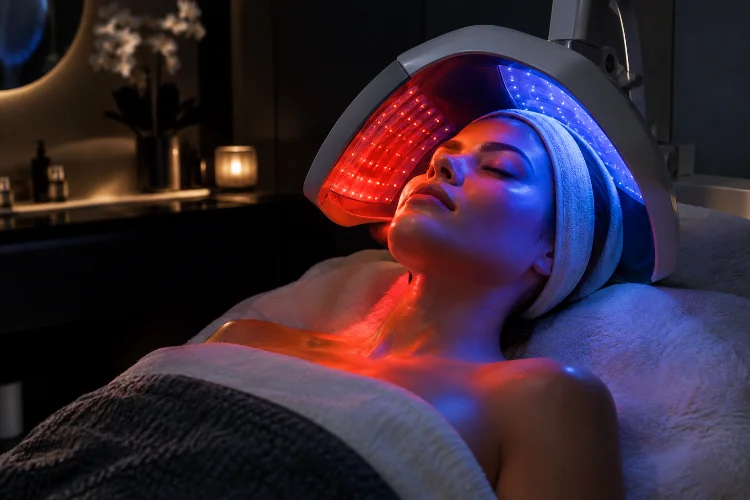
An LED mask may look simple: switch on the device, choose a colour, and let the light do the work. Under the skin, however, different wavelengths can trigger very different biological responses.
Blue light does not behave like red light. Red light does not penetrate tissue in the same way as near-infrared energy.
Even two devices producing similar-looking light may deliver completely different doses depending on irradiance, treatment distance, session length, and wavelength accuracy.
That is why understanding how LED wavelengths influence different skin response pathways is more useful than assuming every coloured light has the same skincare effect.
In dermatology, this concept is commonly discussed under photobiomodulation, or PBM. Rather than heating or ablating tissue like many high-energy lasers, PBM uses relatively low-intensity light to influence cellular processes.
Current research suggests possible effects on mitochondrial activity, inflammation, wound repair, acne-related microorganisms, and extracellular matrix signalling.
The important detail is that biological response depends on much more than colour alone.
Why Wavelength Changes What Light Does to Skin
Light is measured in nanometres, or nm, and different wavelengths interact differently with biological tissue.
Shorter visible wavelengths, such as blue light, are absorbed relatively close to the skin surface. Longer wavelengths, particularly red and near-infrared light, generally penetrate deeper because they experience different patterns of absorption and scattering within tissue.
This changes which cells and molecules are most likely to receive the energy.
Blue light around the 400-470 nm range is frequently studied for acne-related pathways. Red light commonly falls around 630–760 nm, while near-infrared wavelengths extend roughly from 760-1200 nm in cosmetic LED literature.
However, simply knowing the wavelength does not tell the whole story.
Irradiance, measured as power delivered over an area, and fluence, the accumulated energy dose, can dramatically affect the biological response. Treatment duration, pulse pattern, distance from the skin, and number of sessions matter too.
In other words, 630 nm light from two different devices may not produce identical results.
Blue LED Light Targets Acne-Related Pathways
Blue light is most strongly associated with acne treatment.
Cutibacterium acnes, one of the microorganisms involved in acne biology, naturally produces compounds called porphyrins. These molecules absorb blue wavelengths particularly well.
When bacterial porphyrins absorb light around roughly 407-420 nm, they can become photoexcited and generate reactive oxygen species. This process can damage the bacteria and reduce their viability.
That gives blue light a very different biological target from red light.
Blue light may also influence sebaceous activity
The story is not purely antibacterial.
Experimental research suggests blue light may influence sebocytes – the cells involved in producing sebum – and potentially reduce sebocyte proliferation under certain treatment parameters. Anti-inflammatory effects on skin cells have also been reported.
Clinical evidence is promising but not perfect.
Systematic reviews have found improvements in inflammatory acne with blue-light treatment, although many trials have been relatively small, short, or methodologically inconsistent.
A more recent review of at-home red and blue LED devices also found evidence of acne improvement, while emphasizing differences between devices and protocols.
So blue LED should be viewed as a potential acne-management tool rather than a replacement for every established acne treatment.
Red Light Works More Through Cellular Signalling
Red light operates through a different pathway.
Instead of primarily targeting bacterial porphyrins, red-light photobiomodulation is thought to interact with cellular photoreceptors associated with mitochondrial metabolism.
One of the most studied candidates is cytochrome c oxidase, an enzyme within the mitochondrial respiratory chain.
Absorption of red or near-infrared photons may influence mitochondrial activity, ATP production, reactive oxygen species signalling, and downstream transcription pathways.
This does not mean red light simply “charges” cells like a battery.
The response is more complex and dose-dependant. Small changes in cellular redox signalling can influence inflammatory mediators, growth factors, repair processes, and gene expression.
These mechanisms help explain why red-light therapy is studied for wound healing, inflammation, hair growth, and photoaged skin rather than being limited to one cosmetic concern.
Red LED May Support Collagen-Related Remodelling
One reason red LED therapy has become popular in aesthetic skincare is its potential influence on dermal fibroblasts.
Fibroblasts produce collagen and other extracellular matrix components that help maintain skin structure.
Laboratory and clinical research has suggested that red-light exposure can influence fibroblast activity, procollagen production, and enzymes involved in matrix remodelling.
Older histological work has reported changes involving type I procollagen and matrix metalloproteinase activity following LED exposure.
Clinical results tend to be subtler than many advertisements suggest.
The American Academy of Dermatology notes that red-light devices may improve concerns such as fine lines, rough texture, redness, and mild skin laxity in some people, but studies use different devices and treatment schedules, making direct comparisons difficult.
This is an important distinction.
LED treatment may support gradual skin remodelling, but it does not reproduce the tissue injury and collagen response generated by stronger technologies such as ablative lasers or radiofrequency devices.
Near-Infrared Light Reaches Deeper Tissue
Near-infrared, or NIR, light is invisible to the human eye despite commonly being included in LED masks and panels.
Its longer wavelength generally allows deeper tissue penetration than visible blue or red wavelengths.
Like red light, NIR photobiomodulation is studied for mitochondrial signalling, inflammation, circulation, tissue repair, and wound-healing pathways. It may influence nitric oxide signalling, cellular metabolism, and growth-factor responses.
The deeper penetration does not automatically make NIR “stronger” or better.
Different biological targets require different wavelengths.
A 2026 systematic review examining red/NIR-range photobiomodulation for postoperative wounds reported potential benefits for wound healing and pain, but the investigators rated overall evidence certainty as very low because treatment parameters and study results varied substantially.
That uncertainty is useful to remember when consumer devices promise exact percentages of collagen improvement.
What About Yellow, Amber, and Green LED?
Consumer devices increasingly include yellow, amber, green, and even purple settings.
The evidence behind these colours is less established than the research supporting red, near-infrared, and blue wavelengths.
A 2025 review of cosmetic LED applications discusses yellow light, generally around 570-590 nm, as potentially influencing cellular signalling and aesthetic skin responses. However, the clinical literature is still much less extensive than for red and blue phototherapy.
Green light is frequently marketed for pigmentation, while yellow or amber light is often promoted for redness and sensitivity.
These claims should be approached carefully.
A device displaying six colours does not automatically provide six scientifically validated treatments.
Some wavelengths have stronger clinical evidence than others, and marketing names such as “purple light” may simply represent combinations of red and blue LEDs rather than a unique biological wavelength.
The useful question is not, “How many colours does this mask have?”
It is, “What wavelength does it actually emit, at what dose, and what clinical evidence supports that protocol?”
Why Blue and Red Light Are Sometimes Combined
Blue and red LED therapy is frequently combined for inflammatory acne because the wavelengths target different pathways.
Blue light can interact strongly with C. acnes porphyrins, while red light penetrates deeper and may provide additional anti-inflammatory effects.
The American Academy of Dermatology notes that blue, red, and combined blue-red visible-light devices can help treat inflammatory pimples, although visible light is not considered effective for every type of acne lesion, such as deep nodules or cysts.
This is a good example of multi-wavelength therapy making biological sense.
Instead of expecting one wavelength to perform every task, different wavelengths can potentially complement each other.
Still, combination therapy is not automatically superior in every device. Dose, power, wavelength accuracy, and treatment schedule remain important variables.
Dose Can Matter as Much as Wavelength
One of the most overlooked ideas in LED therapy is the biphasic dose response.
With photobiomodulation, more energy is not always better.
A dose that produces useful cellular stimulation may behave differently when exposure becomes too low or excessively high. That makes treatment time and irradiance important, not simply the colour of the LED.
Clinical PBM guidance emphasizes that parameters such as fluence, output power, and treatment duration directly influence efficacy.
This is why copying the session time from another LED device can be misleading.
One mask may deliver significantly more energy per minute than another.
Follow the instructions developed for the specific device rather than assuming that wearing a mask twice as long will produce twice as much collagen.
Biology is rarely that linear.
Home LED Devices Are Not the Same as Professional Systems
Professional and consumer LED devices can use similar wavelengths while delivering very different energy outputs.
Dermatology-based red-light systems are generally more powerful than many consumer devices. At-home masks are designed for repeated use at lower intensities and usually require consistant treatment over weeks or months.
That helps explain why dramatic overnight changes are unrealistic.
At-home LED therapy is better viewed as a repeated photobiomodulation strategy than a single corrective procedure.
Device quality matters too.
Useful specifications include wavelength, irradiance, treatment distance, recommended duration, and regulatory clearance where applicable. A mask marketed only by colour without providing meaningful technical information is harder to evaluate scientifically.
FDA clearance should also not be confused with proof that every marketing claim is true. The AAD notes that clearance relates primarily to device safety and intended use rather than guaranteeing dramatic effectiveness.
LED Therapy Still Requires Basic Safety Awareness
LED treatments are generally considered non-invasive and well tolerated, but that does not mean every person should use every device.
Temporary redness or irritation can occur. People taking photosensitizing medications or living with photosensitive conditions may require medical guidance before treatment.
Eye protection also deserves attention, particularly with high-intensity blue light or devices used close to the eyes.
Research has raised concerns about inappropriate ocular exposure to dermatologic light sources, and specialist reviews recommend using suitable wavelength-specific eye protection when indicated.
People with deeper skin tones should also be thoughtful about visible-light exposure when pigmentation is a concern.
The AAD notes that visible light may contribute to hyperpigmentation in darker skin, making individualized dermatological advice useful before intensive home treatment.
The safest strategy is to match the wavelength to the actual skin concern rather than experimenting with every setting available.
Understanding how LED wavelengths influence different skin response pathways explains why light therapy cannot be reduced to “red for ageing, blue for acne.”
Blue wavelengths interact strongly with acne-related bacterial porphyrins and may influence sebaceous and inflammatory pathways.
Red light is more closely associated with photobiomodulation, mitochondrial signalling, fibroblast activity, and gradual extracellular matrix changes. Near-infrared wavelengths penetrate deeper and are being studied for tissue repair and inflammatory reponse pathways.
But wavelength is only one part of the equation.
Irradiance, energy dose, treatment duration, wavelength accuracy, skin type, device design, and consistency all influence results. Before investing in an LED device, check its technical specifications and choose one designed for your actual concern.
If you have a photosensitive condition, significant pigmentation issues, or take photosensitizing medication, discuss LED treatment with a dermatologist first.