
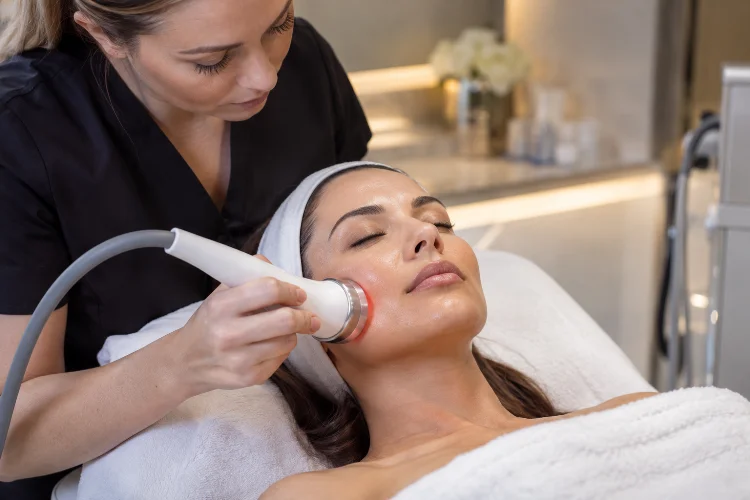
Radiofrequency treatments are often marketed with a simple promise: heat the skin, stimulate collagen, and make everything look tighter.
The biology is considerably more interesting.
Radiofrequency, or RF, uses electrical energy to generate controlled heat inside tissue. Unlike many lasers, which rely on specific light-absorbing targets called chromophores, RF creates heat through tissue resistance to electrical current.
This allows energy to reach selected layers beneath the surface while different technologies control how deeply and precisely that heating occurs.
Understanding how radiofrequency treatments influence collagen remodelling requires separating two processes that are often lumped together: an early thermal response involving existing collagen and a slower healing response that can encourage new extracellular matrix formation.
That second process matters most for long-term change.
Collagen does not suddenly regenerate during a treatment appointment. Instead, controlled thermal injury can initiate biological repair signals that continue gradualy over the following weeks and months, changing collagen organization, density, and potentially skin firmness.
How Radiofrequency Energy Creates Heat in the Dermis
RF devices deliver electromagnetic energy into tissue, where resistance converts that energy into heat.
The intention in aesthetic treatment is usually to create enough controlled thermal stress to stimulate tissue remodelling without causing unwanted injury to surrounding structures.
Non-ablative RF primarily targets deeper tissue while attempting to preserve the epidermal surface. Reviews describe dermal heating as the central mechanism behind subsequent collagen changes and skin-tightening effects.
The exact thermal pattern depends on many variables.
Device design, power, pulse duration, electrode configuration, treatment speed, tissue impedance, contact, cooling systems, needle depth in RF microneedling, and the number of passes can all change what happens beneath the skin.
That is why two treatments both advertised as “radiofrequency” may behave very differently.
The name describes the energy source, not one standardized procedure.
Existing Collagen Responds First
One of the earliest biological responses to RF heating involves existing collagen fibres.
Collagen proteins have a highly organized three-dimensional structure. When exposed to sufficient controlled heat, parts of that structure can denature and contract.
This can produce an early tightening effect.
However, immediate collagen contraction should not be confused with complete collagen regeneration. The more meaningful long-term response occurs through the tissue’s repair process after thermal stimulation.
Reviews of aesthetic RF describe this sequence as an initial collagen-denaturation response followed by new collagen formation and tissue remodelling.
In other words, RF does not simply “melt old collagen and replace it.”
It creates a carefully controlled biological stress that can encourage the dermis to reorganize itself.
That distinction also explains why aggressive heating is not automatically better. Excessive thermal injury can move beyond controlled stimulation and become tissue damage.
Fibroblasts Drive the Longer-Term Remodelling Process
Fibroblasts are among the most important cells involved in dermal repair.
They produce components of the extracellular matrix, including collagen. When tissue experiences controlled thermal injury, a wound-healing response begins, involving inflammatory signalling, cellular activity, matrix deposition, and eventually tissue remodelling.
This process may encourage neocollagenesis, meaning the formation of new collagen.
Histological studies of facial RF treatments have reported increases in collagen types I and III as well as newly synthesized collagen after treatment.
One small study examining non-ablative RF found measurable collagen changes that remained evident months after treatment began.
This helps explain why RF results generally develop progressively.
A patient may notice temporary firmness shortly after treatment, but changes related to new matrix formation require biological time.
Collagen synthesis, deposition, cross-linking, and reorganization do not happen overnight.
Collagen Remodelling Continues After the Appointment
One reason RF results can seem confusing is that the treatment itself is short while the response may continue for months.
The controlled thermal stimulus essentially starts the process.
During the following weeks, damaged matrix components are reorganized and fibroblast-driven repair continues. New collagen can be deposited and existing fibres may become more structurally organized.
A systematic review of RF for facial and neck rejuvenation found histological evidence consistent with repair, neocollagenesis, and new elastin formation across included studies.
Clinical outcomes included improvements in elasticity, wrinkles, tightening, and collagen-related measures, although methods differed considerably between studies.
A newer systematic review likewise describes non-ablative RF as a method that stimulates collagen remodelling and neocollagenesis while generally avoiding significant surface injury.
This delayed response is important when setting expectations.
Judging a collagen-stimulating procedure after several days makes little sense. The biological process needs time to develop.
Monopolar, Bipolar, and RF Microneedling Work Differently
Not every RF device delivers energy in the same way.
1. Monopolar radiofrequency
Monopolar systems typically send current from one active electrode through a broader area of tissue toward a return electrode.
This configuration can produce relatively deep volumetric heating, depending on the system and treatment settings. It is commonly used when the goal involves skin laxity or deeper tissue tightening.
Recent histological research on monopolar RF has reported increased collagen and elastic-fibre density alongside improvements in skin elasticity.
2. Bipolar and multipolar radiofrequency
Bipolar systems pass energy between electrodes positioned relatively close together.
Because current flows between those electrodes, heating tends to be more localized. Multipolar devices use several electrodes to distribute energy in different patterns.
Neither configuration is automatically “better.” Depth, indication, anatomy, and device engineering matter more than the marketing category alone.
3. Radiofrequency microneedling
RF microneedling adds another element entirely.
Small needles penetrate the skin and deliver RF energy at controlled depths, creating localized thermal zones within the dermis. The mechanical needle injury and RF-generated heat together initiate a repair response involving collagen formation and tissue remodelling.
This approach can be used for concerns such as texture, wrinkles, laxity, and certain acne scars.
However, it should not be viewed as simply “stronger microneedling.”
It is an energy-based medical procedure with its own risks.
Why Treatment Settings Matter More Than Maximum Energy
Collagen stimulation requires controlled injury, not maximum injury.
That sounds obvious, but it is one of the most important concepts in RF treatment planning.
Increasing energy, depth, passes, or treatment intensity does not create an unlimited increase in collagen. Once tissue heating exceeds the intended therapeutic range, the risk shifts toward burns and unintended damage.
Anatomy also matters.
The ideal depth for treating dermal texture is not necessarily the same depth used for another area or indication. Facial regions differ in skin thickness, fat distribution, nerves, vessels, and underlying structures.
This is particularly relevant with needle-based RF systems, where energy can be deposited directly at selected depths.
Earlier reviews also emphasize an important limitation in RF research: study protocols and treatment parameters are highly heterogeneous, making it difficult to identify one universally optimal protocol.
Good RF treatment is therefore not simply about owning a powerful device.
It depends heavily on patient selection, anatomy, appropriate settings, and operator experience.
RF Can Influence More Than Collagen
Collagen receives most of the marketing attention, but tissue remodelling is broader than one protein.
Studies have reported changes involving elastic fibres, fibroblast activity, extracellular matrix organization, vascular responses, and inflammatory repair signalling.
RF microneedling creates fractional zones of thermal injury surrounded by relatively intact tissue. Research describes subsequent cellular infiltration, angiogenesis, granulation tissue formation, and later matrix remodelling.
This helps explain why RF may affect several visible features simultaneously.
Improved firmness, smoother texture, changes in fine wrinkles, and reduced appearance of certain scars may reflect overlapping biological responses rather than one isolated collagen effect.
Still, RF has limits.
It cannot recreate the degree of structural repositioning produced by surgery, and it cannot reverse every cause of facial ageing.
Expectations should match the anatomical problem being treated.
Safety Is Part of Collagen Treatment Planning
Controlled thermal injury has to remain controlled.
Temporary redness, swelling, tenderness, and discomfort can occur after RF procedures, particularly RF microneedling. Many studies report predominantly mild and short-lived adverse events.
However, more serious complications are possible.
In October 2025, the U.S. Food and Drug Administration issued a safety communication after receiving reports of serious complications associated with certain uses of RF microneedling.
Reported problems included burns, scarring, unintended fat loss, disfigurement, nerve damage, and cases requiring medical or surgical intervention.
The FDA specifically advises patients to seek a licensed healthcare provider who has appropriate training and experience with RF microneedling devices.
This is especially important because unwanted thermal injury below the skin may not behave like temporary surface irritation.
For aesthetic procedures, the provider should understand facial anatomy, treatment depth, device-specific settings, skin type, previous procedures, and the amount of subcutaneous tissue in the treatment area.
More heat is not synonymous with more collagen.
How Long Do Results Take to Appear?
RF collagen remodelling is usually progressive.
Some people notice early changes in skin tightness, partly related to the immediate response of collagen and tissue. More meaningful improvements associated with remodelling typically develop later as the repair process continues.
The exact timeline varies according to device, indication, treatment intensity, number of sessions, age, baseline skin condition, and individual biology.
Some protocols involve a single higher-intensity procedure, while others use several sessions separated by weeks.
Research supports improvements in several facial rejuvenation outcomes, but evidence is not perfectly consistant across devices. Many studies use different settings, assessment methods, treatment schedules, and patient populations.
That makes guarantees such as an exact percentage of “new collagen” after one treatment scientifically questionable unless tied to a specific validated device and study protocol.
Realistic expectations matter as much as the technology itself.
Understanding how radiofrequency treatments influence collagen remodelling makes RF much easier to evaluate realistically.
The process begins with controlled tissue heating and changes to existing collagen.
That thermal stimulus can then trigger a wound-healing response involving fibroblast activity, neocollagenesis, extracellular matrix reorganization, and, in some studies, changes in elastic fibres.
The visible result develops gradually rather than instantly.
Monopolar, bipolar, multipolar, and RF microneedling systems also deliver energy differently, so device selection and treament parameters matter considerably. Stronger treatment is not automatically better, particularly when excessive energy can injure deeper tissue.
If you are considering RF for laxity, wrinkles, texture, or scars, discuss the device, treatment depth, expected results, alternatives, and potential complications with an appropriately trained healthcare professional before proceeding.